Consumer Agents: Kill Time, Not Tasks

A few weeks ago, before Meta’s Muse launch, I wrote down my first set of thoughts on consumer agents and how I see that category playing out.
I should preface this by saying that I have been bullish on a Consumer Renaissance for the last four months, so the sudden interest and rush into consumer AI wasn’t surprising to me.
Continuing in the vein of that last post, which was largely about the two prevailing theses back then (the Wabi Thesis and the Instinct Thesis), I will lay out how I see consumer agents and this “consumer renaissance” playing out going forward.
True to the grain of this blog, this will mostly run opposite to the current consensus and enthusiasm of the Valley, so I would request you to be patient and let Time play it out.
As with most things, the consensus will eventually asymptote to everything you read here :-).
So here is how I think things will play out in consumer agents, using a16z’s Anish Acharya’s top of mind questions on the consumer agents landscape as context:
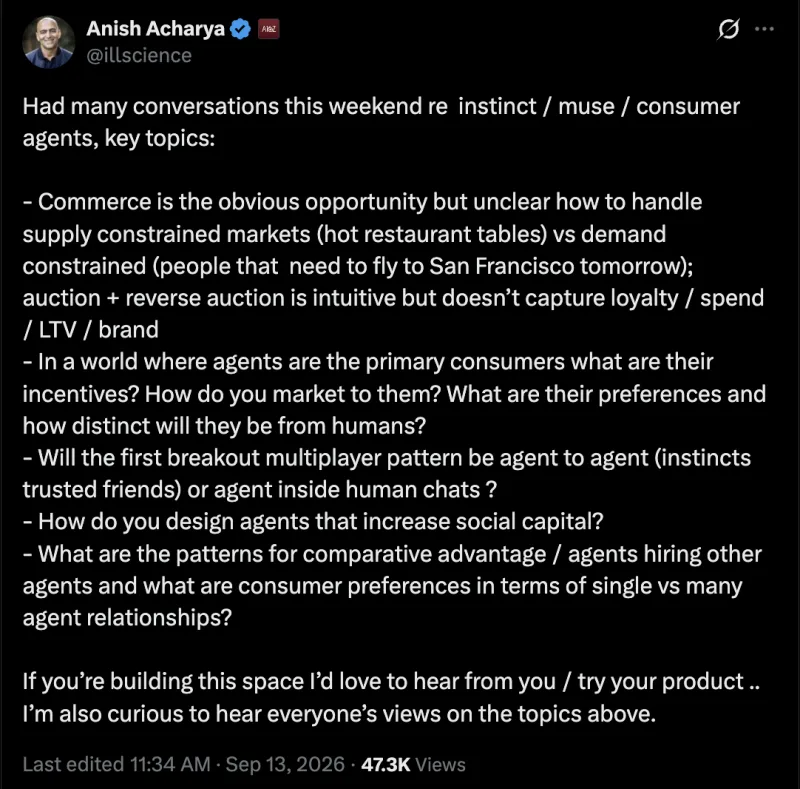
As much as I agree with Anish on consumer apps having a Phoenix Moment, and as much as I like his easy articulation of thoughts (I wish I could write as well as he does, a rare skill), I regrettably disagree with his other takes on consumer.
First with Wabi, then with Instinct, and now with consumer agents as a whole. I understand the enthusiasm around these, however, that is not how I see things playing out.
-
Commerce is not the obvious opportunity. In fact, there will be a very, very tiny TAM of agents buying things for consumers (mostly the rich). Be it shopping, travel or food. Normal consumers see shopping as entertainment and a means to kill time.
-
We will not be in a world where agents are the primary consumers on the internet for purchases and commerce. They will be the primary consumers of information and knowledge, which will mostly be freely available as it is now. We have already come halfway there in the last two years, but this will become more pronounced.
This stems from most people not wanting to put in the effort to use their brains to learn or consume knowledge and information. Knowledge consumption is a Task for humans. Entertainment is Fun for humans. The former needs grey cells to be used, with a very delayed dopamine reward for the brain. The latter provides easy and multiple dopamine rewards.
Knowledge consumption is a Task for humans. Entertainment is Fun for humans.Many have already started to get brain rot, as ChatGPT is their agent for distilling information into a summary or a podcast.
-
Agents are never going to be part of “social capital” or social cohesion. Social begins with humans and people’s reactions and behavior to other humans’ actions. It begins with the core, intrinsic human need for emotions like likeness, love, fame, jealousy and anger. Agents have none of that. There won’t be any social cohesion.
-
Muse will go the Threads way. Lots of users “theoretically”, but mainly a deserted island, not used by consumers as much as Meta is expecting. Instinct is already on a ventilator, just hoping to be rescued by an Apple or Google acquisition due to their VCs’ desperation to get an outcome. Every other existing consumer agent is like the thousands of crypto coins.
-
In summary, the only place where consumer agents will be used by consumers on a DAU basis is where they largely help consumers WASTE THEIR TIME AND HELP THEM WITH EMOTIONS.
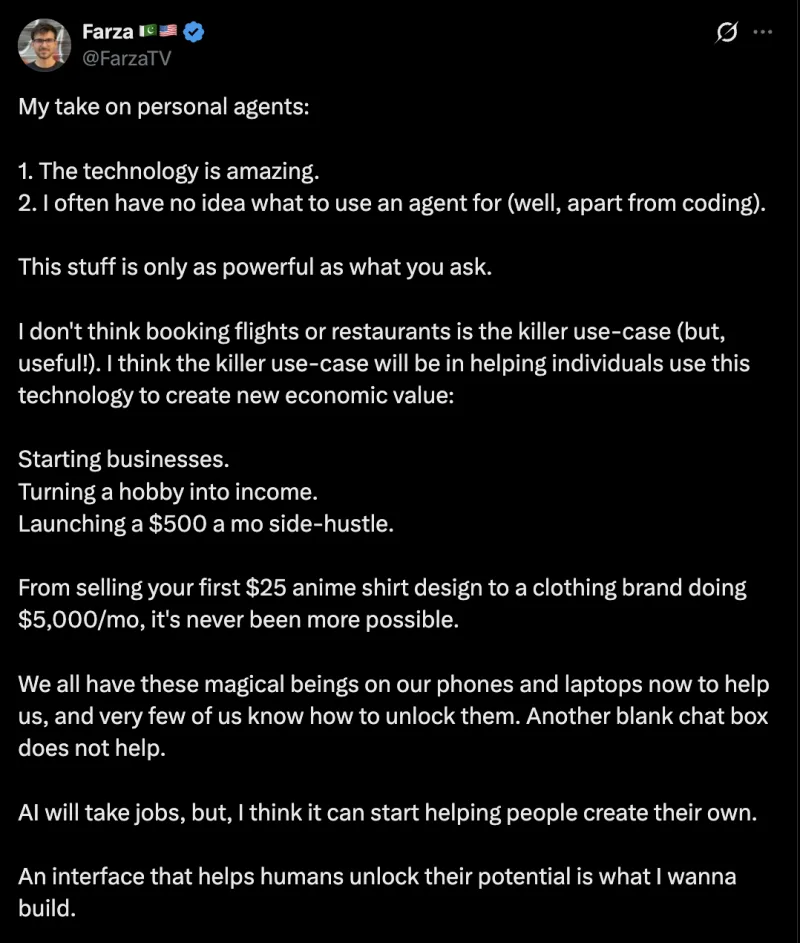
Meaning, giving consumers experiences rather than productivity, automation or make-money schemes (Polsia et al., and what Farza Majeed is recently thinking with Clicky. I do like Farza and root for him, a high agency human).
I believe that time and again, when a certain technology, or a “so called” technology, comes into society, we collectively start to forget what makes humans and society work, and think technology is the panacea for everything.
We have not yet reached the stage of what crypto did to our collective sense as a society at the peak of the 2021 to 2022 bubble, with NFT and Web3 takes. However, the AI belief is nearing that level.
Let Time play this out!