On Consumer Agents and AI's Youtube Moment (Again)
For the last year or so, there has quietly been a revival of consumer AI interest.
The interest was latent and tacit until a couple of weeks ago, when the frenzy came out in the open with Instinct’s $250M raise at around a $2.5B valuation.
Last year it was the high interest in another consumer AI startup, Wabi, a personalized software as mini-apps creation product.
So, as I was expecting a few months ago, consumer AI, which has been a pariah for the last four years due to the over excitement in automating every enterprise workflow with B2B AI startups, is now rising from the ashes.
I should begin by congratulating Instinct for lighting that fire.
The Two Theses
The current thesis, as I understand it in Silicon Valley, is twofold.
The Wabi Thesis. We are entering Software’s YouTube Moment, as very articulately laid out by a16z’s Anish Acharya last year when they invested $20M in Wabi’s seed. The simple idea is that just like with YouTube, everyone got empowered to create their own videos and a whole creator economy opened up. With AI, people will create their own personalized software, mini apps as Wabi lays it out, and they won’t need to go and download other people’s apps.
The Instinct Thesis. Personal background agents that automate all your personal tasks, running through a universal iMessage or text interface, are the future of the consumer AI experience. It lays out a compelling argument that after more than fifteen years there is an app fatigue, and since AI agents can work in the background the way your own personal human assistant would, “UI is pre AI” and no UI is the future.
I respect both arguments, and I loved Anish’s well composed article. However, just as I disagreed with the premise of that article last year around Wabi’s seed round, I unfortunately disagree with Instinct’s thesis as well.
These are my personal convictions based on my own understanding of consumer and human behavior, so you should feel free to disagree. However, I would still stick to it even if 8 billion people felt otherwise. As I have always said, as one of my mental models:
My Core Thesis
Consumer products are driven by human behavior. And human behavior seeks Experiences over Automation.
No amount of force and money can fight that.
In July of 2025, when most of the clamor in the Valley was around agentic browsers, with OpenAI launching Atlas and Perplexity launching Comet, I wrote at that time that the agentic browser is a dead on arrival product, because it will not get adopted by consumers.
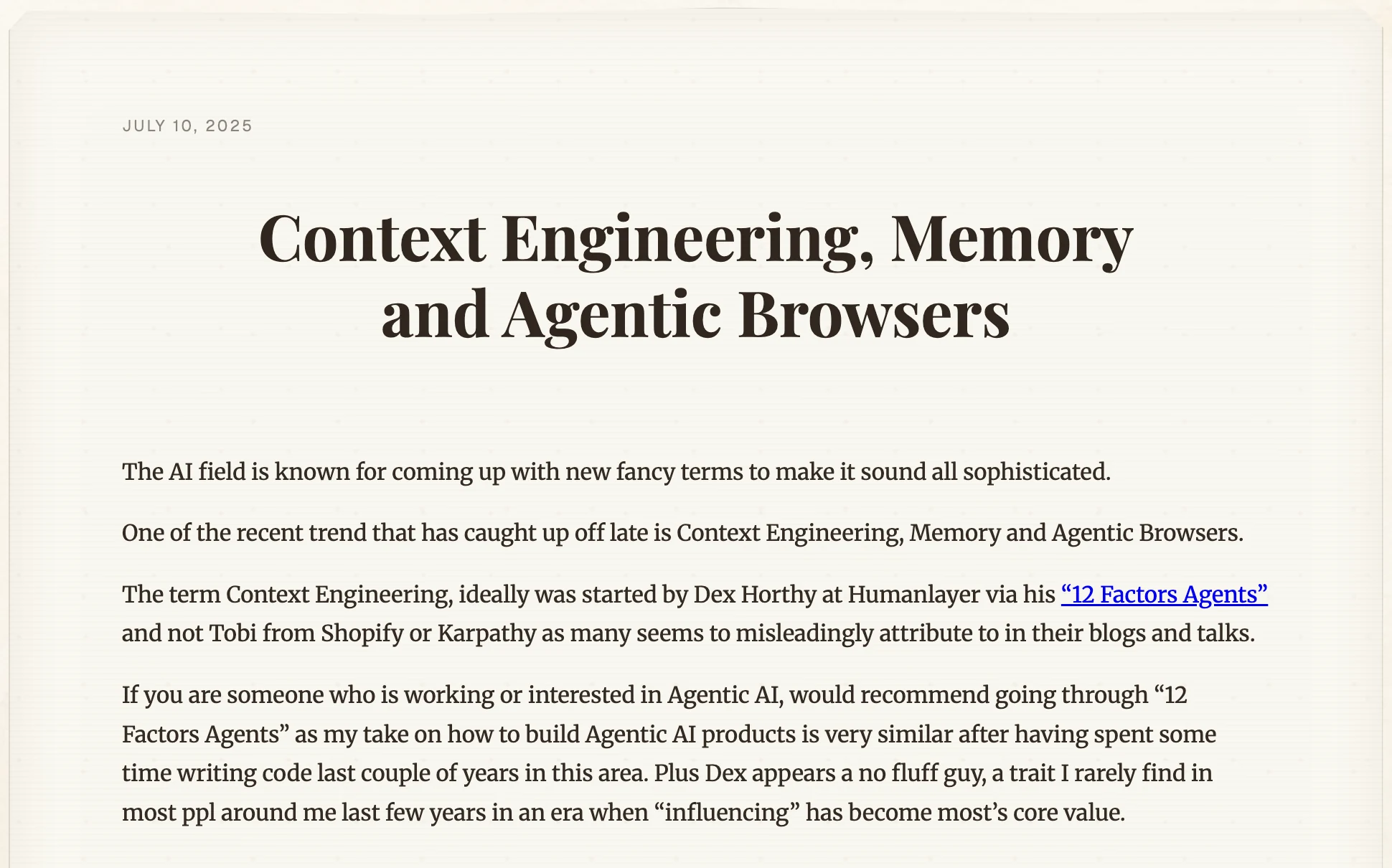
At that time it was not a popular opinion. In classic Silicon Valley style, why would anyone not use agentic browsers if they could automate their tasks? After all, tech people love automation and saving time, so why would everyone else not love it too.
The core argument I made then was this:
The former needs good functionality and capability. The latter needs to deal with human behavior.
And human behavior is the biggest hurdle that will not let consumers adopt agentic browsers. Consequently, a year later, both Atlas and Comet are shut down, exactly as I wrote back then. That might be a surprise to a few, but definitely not to the people who read it at the time.
Similarly, I disagree with the current consensus on consumer agents, for both the Wabi and the Instinct thesis.
In the consumer space, my personal conviction is that products do not become successful because of great features and time saving capabilities. They become successful when they meet a human behavior capability.
There is also the matter of the device.
In the consumer world the device of usage is the phone. In the enterprise it is usually a desktop or a laptop. That difference matters far more than it is given credit for.
Both Wabi and Instinct are trying to sell automation to consumers. While a normal consumer uses phones largely for communication or for experiences. Not for automation.
That is antithetical to what consumers actually want.
Why Wabi Fails
I wrote last year that Wabi will unfortunately be dead on arrival in spite of a beautiful product, because it fails to understand one core human quirk:
This is what I wrote at the time, in November 2025.
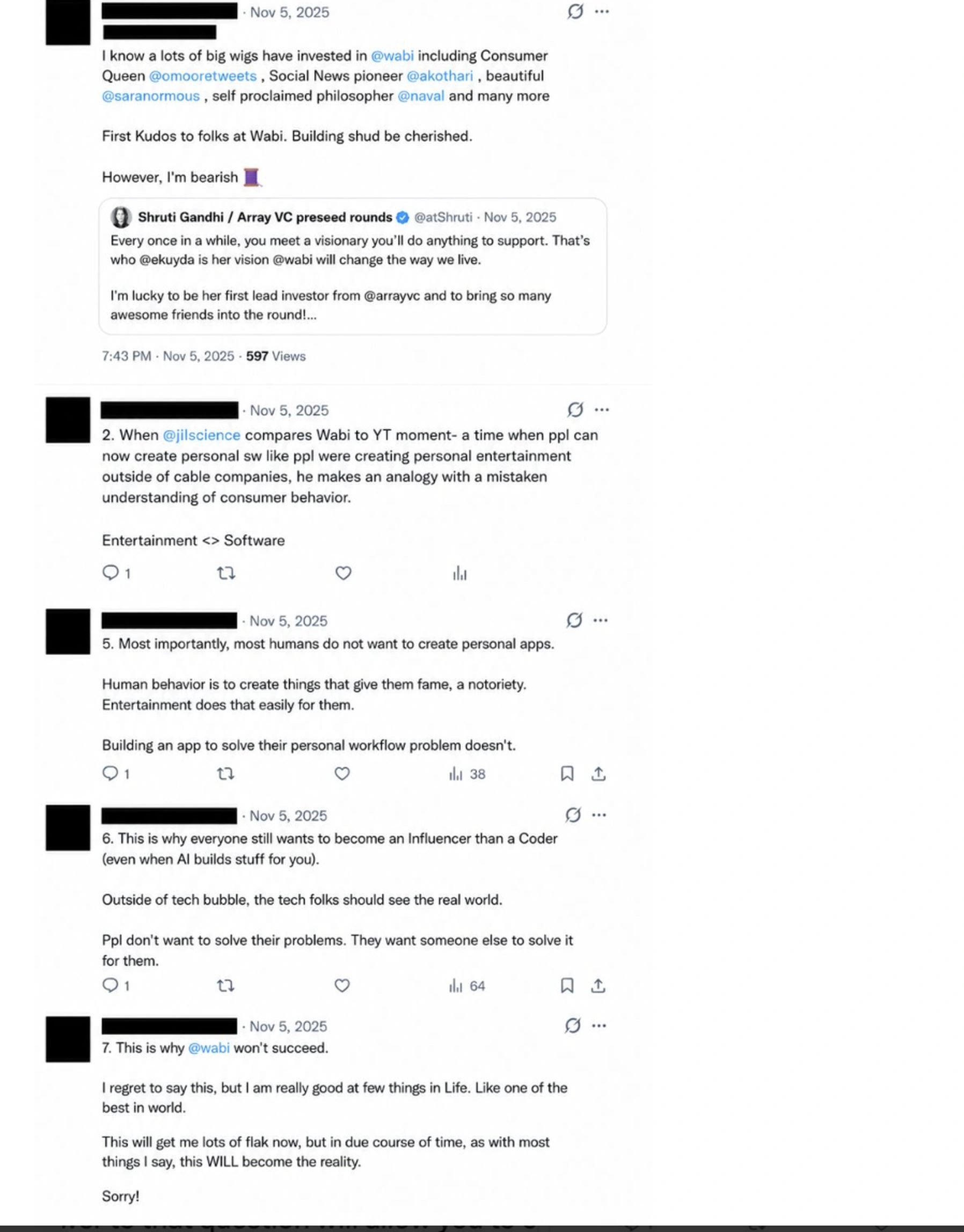
Human behavior is to do the things that give you notoriety and fame, rather than spend a few brain cells figuring out a workflow automation for a problem you might be facing.
That is the reason it is easier for people to yap on social media and become an influencer than to build mini apps, even when AI does the building for them.
Why Instinct Fails
Similarly, in spite of the near consensus and the hype around Instinct in SF these last few weeks, I will take the same position, that a year from now it will not have found the consumer adoption it is hoping for.
Not because it is not a good and capable agent. In fact, I like the backend agent engineering that has gone into it.
But it fails to understand another human behavior that I focus on:
Texting as a channel for doing things is an information overload medium. Our brain does not register texts as overwhelming even when there are thousands of them from friends, family and the people we love. But it starts to freak out the moment they relate to tasks.
So it will not matter how much automation you give consumers. Text as a medium is not the interface people will adopt.
This was the same reason I wrote last year that Poke would fail as a product, because it would not get adopted by consumers. Instinct is just a better and smarter Poke. The medium is the same.
There is a deeper problem with selling time saving to consumers.
People don’t use phones to save time. They use phones to kill time.
Most people wake up every day, go to work, come home, watch Netflix, scroll through other people’s lives online, and do it all again the next day, consistently, until they die. Their life is ordinary and mundane, and doom scrolling on the phone is how they try to make it feel exciting.
They go to their phones looking for experiences. Not automation.
Their emails don’t have any hidden treasure they need an agent to find.
Another YouTube Moment, Not Software’s YouTube Moment
This brings me to my final argument.
AI will not lead to Software’s YouTube Moment, as Anish argued last year in his earlier article. This will be revealed when Wabi, which I already believe is a dead man walking, and I wish I was wrong since I have a weak spot for great UX, either pivots or shuts down in spite of raising a lot of money.
However, AI will lead to another YouTube Moment.
Meaning consumers will not create software using AI, which is the Wabi thesis failure. They will create more personalized content, cartoons and movies, without having to appear in them the way the last decade of the YouTube Moment required.
Fal just post trained a model that creates a 15 second video in under 9 seconds. You can generate videos on demand faster than a human can finish watching them, giving an infinite stream of on demand personalized video creation without a content creator having to take part in it.
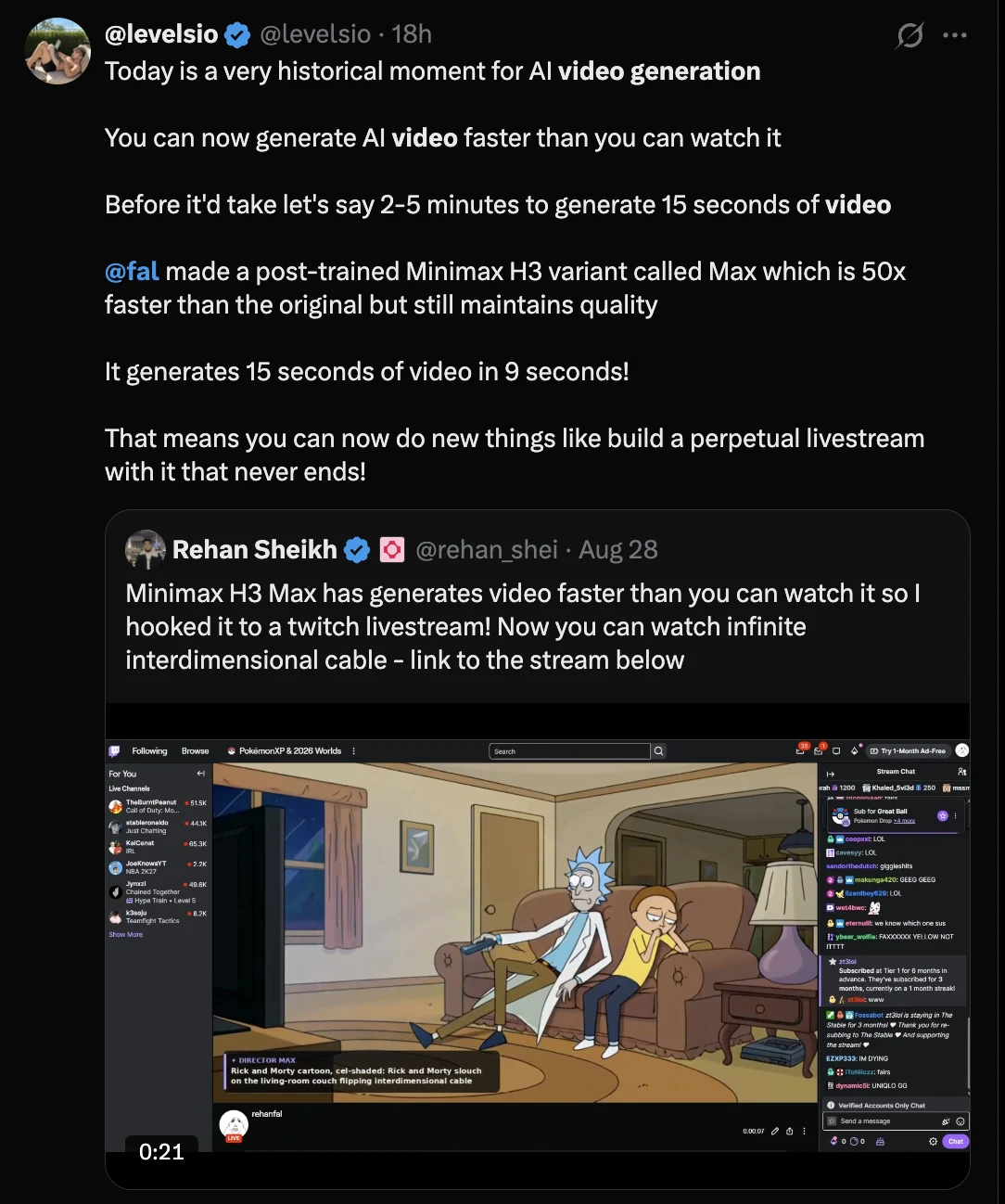
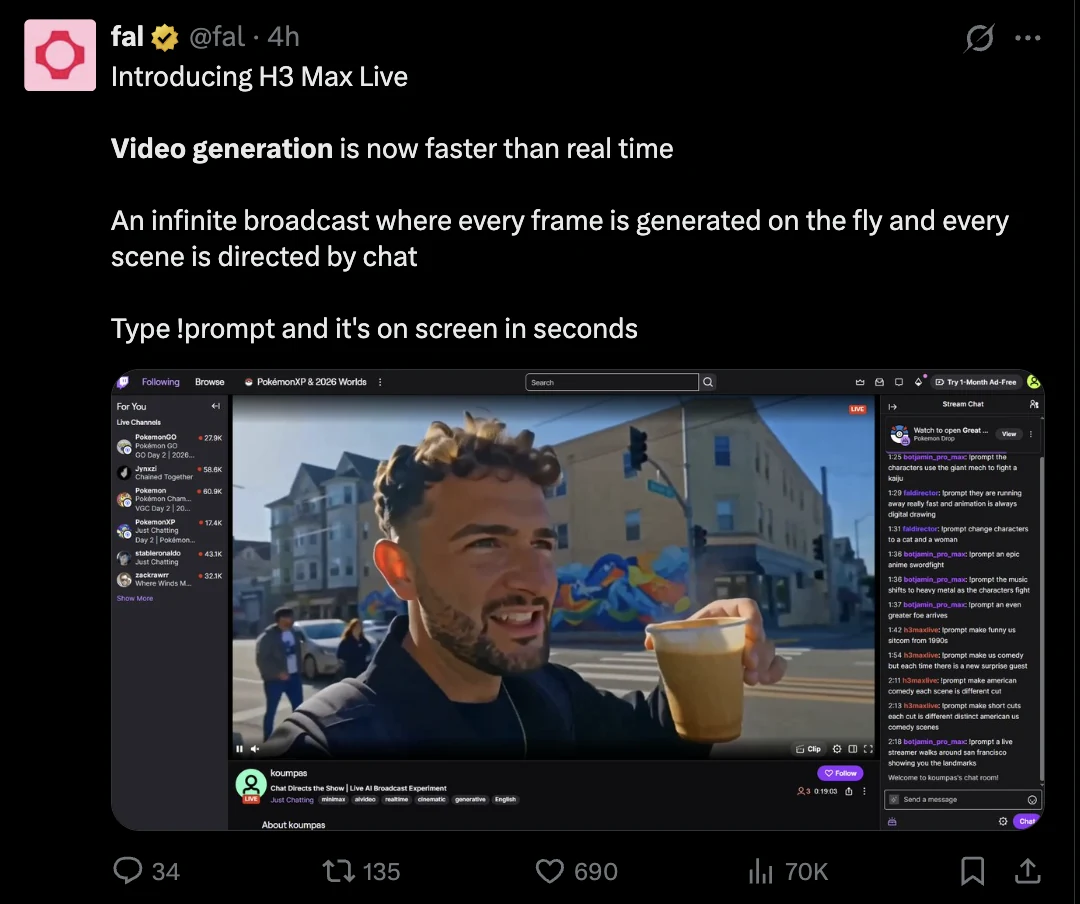
They have already shipped it as an infinite broadcast, where every frame is generated on the fly and every scene is directed by whoever is typing in the chat.
Now, all of this is AI slop. But AI slop, when it is funny and creative, is entertainment. And as argued earlier, people want to do the things that give them fun, notoriety and fame. Entertainment does that for them far more easily than building software ever will.
So do not be surprised if you witness a YouTube like platform that carries nothing but AI created live streaming of personalized stories and cartoons, running 24/7 as an always on show. No humans anywhere in the videos, and now you have an endless YouTube of AI shows.
AI leading to YouTube’s yet another YouTube Moment.
In Conclusion
Both Wabi and Instinct, in my personal opinion and regrettably so, as my heart wants both of them to succeed while my brain says otherwise, will fail to get consumer adoption. The same fate that unfortunately befell agentic browsers. Wabi is already there, and their founders, like any optimistic founders, have not yet admitted it. Instinct will take a year or so to get there.
We will witness AI leading to YouTube’s yet another YouTube Moment. Software’s YouTube Moment, in my opinion, will never arrive.
None of this is written to wish anyone ill. My personal disposition is to see everyone succeed, because I believe that prosperity is seeing everyone prosper.
That is why, with people who have talked to me or approached me, I love to help them with their product unsolicited. Design, product, technology, anywhere I feel I can help them make it better. With no expectations of anything in return.
However, I also rely a lot on my ability to see human behavior, and I go with my conviction on what I see.
And there does not exist any force in the universe that can bend it to its will.
Consumer products are driven by human behavior more than by any technical capability, and this is the bet I am taking against the current Valley thesis.
Let time play it out, as it always has.